The file is available here on Zenodo.
The file is available here on Zenodo.
With three weeks left of the summer, there is a lot of work to be done, and this week there was no slacking. Not an ounce of slacking to be seen. The Visionary Cross viewer has received another facelift. The navigation was reworked again and it’s very nice. We stepped away from the navigation look of Caedmon’s Hymn edition and made a new layout that works better for the project. It is no longer built on the idea of a circle but instead exactly how anyone thinking of navigation would imagine it’s built. I also tried to make the headers smaller as per the boss’s request, but I think there is something in the CSS controlling the size because it looks the exact same as before, but now with reduced quality.
Draft emails were created for PURE3D and the Smithsonian, but they have to be reworked a little bit. Additionally, it was decided that I should go find out everything I can about how they work before the emails are sent. After all, nothing would be more embarrassing than us asking a question which could be answered if we had just read the website. Based on the reading I have done on the Smithsonian’s 3D group, I have really high hopes. It’s open source and API-based. This is exactly what we need. Hopefully we get an update on all of that in two weeks.
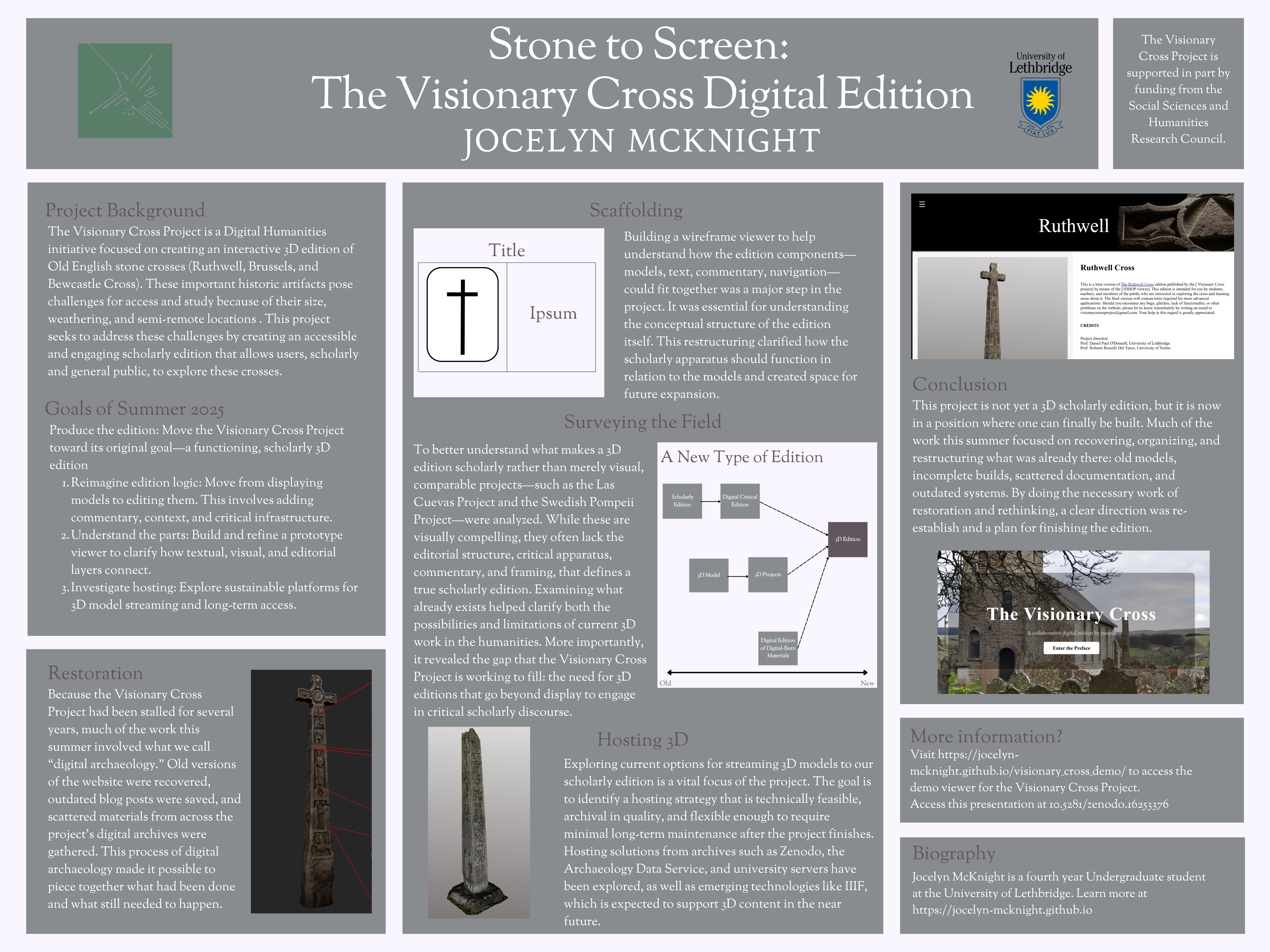
My poster is ready for the symposium. It is beautiful and aesthetic, and I removed the spelling errors. It focuses on what the goals were for the summer and then four key areas that I was working on: restoration (so basically, figuring out what we had and if I could save anything from different eras of this ancient project), scaffolding (making preliminary versions of the edition and getting blueprints for where we are going), surveying the field (looking at what everyone else has done and innovating off of them and figuring out what we would need for a 3D edition), and finally hosting 3D (which, as we know, is the bane of my existence as I struggle to find anywhere that will let us stream our models). I made some very nice diagrams for the concepts and included recognition to SSHRC as they funded us and we are required to recognize them during every presentation. It turned out well and now I just have to send it in to get printed (even though really the university should be paying for it, considering they are requiring me to give a physical poster, and it costs $50).
The course book is going well, and we moved around some stuff and expanded other sections. Dan explained that my revised order of the modern English grammar lessons would not do, and so they have been put back and the syllabus has been fixed. We used ChatGPT to make up 15 extra sentences for Mitchell and Robinson’s Practice Sentences C because we want every student to have one sentence. Of course, not all sentences are made equal, but that’s life and 5 students might suffer. GPT did an excellent job. We were able to prompt it into extracting exactly what grammar features Robinson was trying to teach with his sentences, and then we got GPT to make its own sentences with the same features in mind. We went through them and made sure nothing was too complicated (switched out one of the verbs) and plopped it into the Obsidian with the other sentences. I haven’t checked the glossary in the back of the book to see if all the words are there, but I can’t imagine sentences so basic wouldn’t be applicable to that glossary.
As for the Peterborough Chronicle, I have been doing stuff. We decided that the Pre-Roman Preface was too short, considering it was only 7 sentences or something like that. So, we’ve been looking for more passages. We decided the ones in Evan’s Old English textbook were acceptable, but the only problem is that I left the book in the lab, and I don’t have an online copy, and it’s not available from my sketchy websites. I haven’t quite decided what to do yet, because I found an edition of the Chronicle from a couple of years ago which is very nice, but the great thing with the Evan’s book is that there were specialized glossaries for the passages. So, the plan was to use that class to teach glossary. However, if we just pick 3 more paragraphs of around the same size (7 sentences), then we could do fun things. For example, there could be 4 groups and that day could be done in small groups instead of as a whole class, with the TAs and professor circling and supervising. That could be fun for the first taste of real Old English. Nevertheless, no matter if we use Evan’s or some passages I like, an introduction will have to be written so it matches Mitchell and Robinson’s style. About 1 page will do it and I call dibs on that task.
One more issue is that none of the editions have diacritics in the same way Mitchell and Robinson do. There’s the occasional macron on top of an i or a u, but Mitchell and Robinson are diacritic enthusiasts. Do I try to add the diacritics to the texts (Evan or edition—both would need them)? Or will it even make a difference? I don’t know if the students are paying that close attention to them, and for me, I don’t even remember using them that much. Maybe it’ll make pronunciation harder, but really, I’m not qualified to make editorial decisions of that scale on anything. As we move towards the end of summer, it’s time to start filling in the content, like the nouns and verb sections. After all, everything that I could take for the course book was taken, and there is just new stuff left.
Happy thoughts. You’ll hear from me in 2 weeks, as I take my well deserved vacation.
]]>Visionary Cross–wise, I was a little lost. I think I did all the memorable tasks on my list and was left to my own devices. I started revising the Stolen Blogs/Scanning information, but then I decided to email Marco to ask if he had any notes or remembered anything.
I also did some reading on the Ruthwell Cross. Initially, I was trying to add sources to the scanning section, but then I decided to cut that first paragraph (which really would have required the most sources). I read, although not too thoroughly, Catherine Karkov’s article Thinking about Stone and skimmed the parts that looked interesting in Kerstin Majewski’s book about the Ruthwell Cross. Many moons ago, I wrote an objectively bad unessay about runes, and I know it wasn’t great because I actually learned a lot just from skimming this book.
I organized the Obsidian notes based on what I had written on a Canva after our last meeting, and it’s looking good. Weeks 1–7 are very solid (except I fear the first two weeks might move too quickly). After that, it falls apart a bit, but the beginning is strong. I also reorganized Dan’s grammar lessons. I moved the inflection lesson after parts of speech and grammatical function. I just feel that parts of speech is the easiest topic and should come first, while inflections is the hardest and should go last, but I’m sure there’s a reason for the original order which will be explained tomorrow.
Now, let’s talk about the information I’ve been gathering. Dan emailed a colleague in the Netherlands, which sparked a very long email chain filled with lots of useful information. Some labs build their own widgets, but keeping old projects streaming is a challenge. That’s not great for us, since I doubt we’ll be building custom widgets. Some groups work with their own servers. One person suggested looking into the capabilities of Dataverse and Knowledge Commons, but when I skimmed those, they seemed similar to Borealis, and I couldn’t find any 3D data stored on them.
Dan also sent me more resources. There’s the Smithsonian Voyager platform, which hosts a bunch of very cool 3D models, and Pure3D, which specializes in publishing 3D scholarship and editions. Pure3D even streams from some of the old famous projects, like The Battle of Mount Street Bridge. I’m not sure if he wanted me to email those people or find out everything I can about the programs, so I await instructions.
Also, I got an email from the research office because it’s time to fulfill my deal with the devil. When I accepted the funding to be a research assistant this summer, the only condition was that I present at the Summer Research Symposium. And now they’ve come for me.
I’ve been preparing my poster, but I’m feeling really conflicted. Do I just use the presentation from the CSDH-SCHN poster? I already have a 3,500-word script for it, and it would be so easy. Or do I stick to the abstract I originally submitted? The problem is that the abstract is so bland and vague. I had a 250-word limit, and even the full proposal, about two pages long, doesn’t say much in terms of argument. It’s mostly just a description of the project and its goals. But doesn’t a poster or presentation need to say something interesting? Otherwise, I’m just a used saleswoman reciting information you could read on the website.
I feel like I need to have a point beyond “This is the Visionary Cross Project. They pay me, and I do stuff. I’d show you the stuff, but this is a physical poster so I can’t show you the model—here’s a picture of it.” And showing a picture of the cross is defeating the whole point because what if someone asks me “why does the edition have to be 3D if you have a picture of it there?” I will have to just walk out.
Also, I don’t want my poster to be too similar to the others in the hallway. One summarizes the scanning process (I should go look at it and pull info for our scanning documentation), and another is about the Zenodo linking, which fell apart a few years ago. If I need to spice up my poster, maybe I can bring my computer, place it on a stool in front of the display, and let people play with the models. I could put the crosses on my VR machine to distract from the lack of a strong argument in the poster. I don’t know.
I also got my computer fixed.
]]>I had two important and long meetings early last week. The first was with Marco, who gave me a crash course on the Ruthwell and Bewcastle data. Ruthwell is a bit chaotic at the moment, so we’re working on cleaning and organizing it, as well as adding more README files to make it more user-friendly. Bewcastle, on the other hand, is in much better shape and just needs a few additional README files. We also discussed our Zenodo backups—specifically, what actually needs to be included. Some files don’t need to be archived there in order to have a complete backup of the data.
Unfortunately, we also had to talk about some of the outdated software, particularly the tools used to color the Ruthwell Cross. This is one of the drawbacks of working on such a long-term project, technologies become obsolete.
We’ve also been discussing IIIF technology. While it isn’t fully ready for 3D yet, it’s expected to support it within the next year. ADS mentioned that we might want to consider IIIF for our edition. However, that would mean either delaying the release of the edition or reworking it later, neither of which is ideal.
The second meeting, just ten minutes after the first, was with the Library Research Group, who were presenting Borealis, the new archive the library is adopting. It was an interesting presentation, but I don’t think Borealis is a good fit for our project. It doesn’t offer anything Zenodo doesn’t already provide, and it likely can’t support streaming content since users have to download the data rather than view it online. There’s also the issue of access: collaborators from outside Lethbridge or Canada, or those who leave the university, would lose access. So, while it’s a very cool, Canadian-hosted archive, it’s not the solution we need.
I also updated the Obsidian vault to match Dan’s setup exactly. All the slides have now been added (not without some struggles) and stole all the best Old English tutorials from Dan’s website. This is a short paragraph, but I promise it was actually a lot of work and in that first week I didn’t even have time to organize the files.
]]>Next, I took all the information from the blogs—plus the bits I salvaged from the current Visionary Cross website—and reconciled them into a rough “chapter.” It’s far from ready for public view, but it’s now in a state where Dan can review it. When he gets the chance, he can use the content to shape the chapter into his vision.
Then I tried to put the 300MB file in Dropbox and stream it in. It felt like the Zenodo situation all over again, but I had to try—because using a 100MB model would be truly tragic. I thought it might work since Dropbox can apparently stream things like videos and sound. Alas, Dropbox has also failed us, just as Zenodo did many moons ago.
Until we have clarity from ADS, we’re in a tough spot. Do we stick with GitHub and use dreadfully low-quality models, keeping the high-quality versions tucked away on Zenodo? Or will ADS be our solution? For now, we await the decision of the ADS management committee.
While the Linux install was a great success, there were a few stumbles. I wanted to dual boot the computer, just in case—but when I went to partition the disk, it wouldn’t let me. I had mentally prepared for this moment and was determined not to mess it up, so I logged into Windows to try from there. Unfortunately, whether because I was using a limited account or because it’s a university machine, I couldn’t access the disk management tools, so I couldn’t reallocate space.
The only option was to go back into Linux, wipe the whole computer, and install the OS clean. One might wonder, “But why didn’t you just go in as a Linux superuser and use the green USB stick Dan kindly gave you to back up everything first?” So, the computer was wiped, Linux happily installed, and I proceeded to download the Dropbox ZIP files Marco gave me with all the Visionary Cross data. I also installed Zoom and Slack, rearranged what was pinned, and called it a day. Great success. My new skills were tested and I passed.
I meant to do more for the textbook, but what I did manage is a good start. A fellow student was frustrated with Notion trying to make her pay for more blocks, so she switched to Obsidian. Naturally, I told her to find a way for us to share a vault so I could lurk in her notebooks and keep tabs on a paper. A community plugin called Relay was wound to be the solution. It’s a free way to share folders in a vault, as long as fewer than three people access them. This could be an interesting way to work on the notebook before it’s published to Quartz.
Rather than using forks in Obsidian and having Dan reconcile what he likes, he could just see what I’ve done and what he’s done and take whatever he wants. At the end, I’ll publish it on Quartz and GitHub. How nice would that be? We shall see if that’s the route we take.
I started Chapter One of the textbook, which focuses on linguistic and historical context. I’ve divided it into six sections that I believe are essential for Old English: • “What is Old English” • “Pre-British Isles” • “Migration” • “Dialects” • “Danelaw and Vikings” • “Norman Conquest” (with plans not to dive deeply into this one, as it’s less relevant to the course) My favourite book on the history of the English language is The English Language by Charles Barber et al. But I’ve also looked at how Mitchell and Robinson introduce the history, and how Baker does it. These three styles are very different: Barber is thorough and lays everything out clearly; Baker discusses the evidence and primary sources that support his claims; and Mitchell and Robinson spend two pages on the history and move on. All are valid ways to introduce historical and linguistic context—and now it’s my job to decide what the priorities are for this textbook.
For now, to make the page look a little less sad and empty, I’ve pasted in an introduction to Old English from an essay I wrote last semester. So, the chapter is a bit patchy and weird at the moment.
Another slight issue with having me write the historical chapter is that my knowledge of Old English history is very focused. I tend to only know the parts I’ve needed for essays. I know a lot about language contact and Old English, I know about pagan religion in Old English, I know about runes (to an extent), and I know about women in Old English. None of this gives me the kind of grand overview I need to write a chapter like this. Most importantly, I know nothing about the political landscape or major historical events, because my interest lies much more in the language than the period. Still, this shall not stop me.
]]>I presented my “If I Were in Charge” syllabus for Old English to Dan, and he was intrigued, especially by the idea of reorganizing the first few classes. We’re now thinking of starting with practice sentences (as usual) so students can focus on Old English spelling and sounds. In Mitchell and Robinson’s book, there are three practice paragraphs, but if we need more, we can always create some fake Old English ourselves. Next, students will learn how to use a glossary with a simple text. The main contender for the fall course is the Peterborough Chronicle Preface: Pre-Roman Britain. It’s a very simple paragraph, and if we use a handout from Jonathan Evans’s Old English book, there’s a customized glossary just for that passage, so students would not be overwhelmed by a full multi-page glossary. Then again, maybe it would be good to throw them into the deep end of glossary work on a simple text.
After the glossary introduction, we’ll cover English grammar, which—according to various articles on teaching classical languages—is the most useful part of learning an ancient language. Students will strengthen their foundation in Modern English grammar and then expand outward to Old English grammar, which is not that different. By this week, we should have the texts finalized and be ready to start pulling examples for the textbook. There are just a few pieces we might want to swap or add, such as Wonders of the East and the Preface to Pastoral Care. It also looks like Judith is the top contender for the poetry section since we are trying to leave all potential pieces for an advanced class in the spring out of the introductory class. If this is the case, it could be fun to do some excerpts from Beowulf with Judith, just because Beowulf is the most well known and the advance class wouldn’t be able to study it. Also, the students can be cultured, if we do some excerpts.
The Visionary Cross Project also had some interesting developments. After a meeting with Roberto, it was tentatively decided that we should have the basic humanities content filled out in the edition and maybe run a workshop in November to complete the rest. As a poor undergraduate student, I’m not entirely sure what this entails, but that’s the plan for now.
The 3D model data is being sent over from ISTI-CNR Pisa, thanks to Marco. But where, you may wonder, will this data be stored? Certainly not on my laptop. The plan was to store it on the fancy lab computer, the Dell T7910, known for its “outstanding productivity.” It used to be the lab’s pride and the host for all project’s data until it broke down many moons ago. It was never fixed by IT because we feared they might wipe the memory. But after three years, we finally needed to fix it.
So, on Thursday, Dan and I spent four hours troubleshooting the computer, and here’s what happened:
All of this led to our big discovery: the precious fancy lab computer which is known for its high quality GPU and fast processing is missing half of its CPUs. As a non-computer scientist, English major, linguistic enthusiast, I did not know what a CPU was. Now I know that the CPU is the brain of the computer and responsible for the processing (hence the name central processing unit). You might be wondering what happened to the beloved CPU of the lab, there are strong theories, but we might never know for certain…
Anyway, what now? We can’t really use the computer: even with the Linux key, it’s painfully slow. Replacing the CPUs would cost somewhere between $600–$1000 on eBay. So, our plan is to steal the hard drive and put it in the working (though less fancy) desktop. We consulted GPT and it affirmed that this is a great idea and it will hit in the other computer and we just need a screwdriver.
So, that’s where we got to with the computer drama. Although we were not able to retrieve any lost data or prepare the computer for incoming data from ISTI, it was a productive lesson for me. I got to see the joys of Linux in action, and now that we have a working USB key for Linux, it is a goal of mine to start converting some of the lab desktops with nothing on them into Linux computers for fun. Worst case scenario, they lose nothing, and I give them to IT and keep trying.
]]>So many moons have passed since I started my summer grant work that it’s hard to decide where to begin. The Visionary Cross Project is the core of the grant, so I should start there. The layout and aesthetic have improved tenfold. I had my doubts when Roberto gave feedback on my 2.0 design back in December, but he was so right. Now we just need real humanities content to replace the placeholder ipsum (and there’s a discussion coming up this week, so stay tuned).
After the CSDH Congress, my work on the project hit a bit of a standstill. The trip threw off my rhythm, my mojo, but I’ll get back on track. You know what would help? A new mission. The interface is done and beautiful, and I’ve done everything I can for now. Negotiations with the ADS are underway, and soon we’ll find out if we can use their archives to stream. So it’s time for me to focus on the data. But what exactly does that mean? Nathan told me 3D data is very complicated, and all these things need to happen, but I still don’t know what I need to do.
However, I did see that there’s talk of fixing the Brussels Cross and redoing it with updated software. Say no more. I want that job. I don’t know how to make 3D models, but I could learn.
I’ve been considering how the 3D model works with the edition. When Shara showed her pdf demonstration of how we could display the model, it made sense to me. When you clicked the panel description, the 3D model automatically moved to show that panel. It was guiding the reader. Is that what we want to? But then we’re just using the model like a static image and that is not the point. The design of the edition needs to encourage the reader to use the model. The model is the star of the show.
Let’s backtrack to the conference. It was a good presentation. It was a long presentation. It had an argument but it was a whinny argument because there was a minimal solution. However, one of the conditions of my grant is that I have to present at the university’s summer symposium, so I have a month and a half to turn the argument from “there’s not 3D editions” to “look at this beautiful 3D edition that combines the best parts of digital editions, 3D projects, and more. As for the Old English textbook, things are being done.
This week, Dan was corresponding with a fellow prof of Old English about Old English course design and textbooks (and what would be nice in an Old English textbook). It’s proof that my idea for an unessay last semester would have been brilliant. I wanted to survey Old English professors about what’s missing in current textbooks, so that when the time came to write one, we’d know exactly what to include. I ended up doing a different unessay, but clearly I was onto something. The Prof. mentioned something I’ve been thinking this whole time: the textbook should use examples directly from the course readings. So how can I start writing a textbook without knowing which texts will be taught? Just leave gaps for obviously. But I need the final reading list before it’s done.
I drafted a rough outline based on all of Dan’s syllabi dating back to 2006, a half finished Todoist list, and other syllabi from the internet. Until otherwise convinced or reprimanded, the book will have eight chapters:
Now, about the texts: I’ve been torn. Part of me thinks the Old English poetry course (rebranded Advanced Old English) should run in the spring and use Eight Old English Poems. The dilemma is that Caedmon’s Hymn and The Dream of the Rood are both in that collection and have been in Dan’s syllabus since 2007. Should we remove them in the regular course to leave space for the more advanced class? But Caedmon’s Hymn is perfect for a quick paleography lecture and a gentle intro to poetry. Also, if a dedicated student were to add up all the lines in Eight Old English Poems, they’d find only about 850 lines total. Is that really enough for an advanced course? That’s not even a third of Beowulf.
The Vercelli Book is more promising, about 3,500 lines altogether, and even longer than Beowulf. But all of this is beside the point and not my task. The question is: Which texts should I be using for textbook examples?
While I’m sidetracked with course design, let’s talk compositions. Composition is one of the main reasons I want to write this textbook. Back when I took Teaching and Learning Second Languages, I designed a project-based learning plan for Old English centered on the Colloquy of Occupations. It heavily emphasized mini compositions.
What if, instead of using the whole PBL project, we just used the composition idea? Something simple: students write one or two sentences in class, on paper, using a word bank. The goal would be to confirm they can use the proper demonstrative, choose the correct noun case, and conjugate verbs correctly. Doesn’t that sound so nice and useful?
I blog every week now.
]]>